ORIGIN: Hindu (Puranic)
TYPE: Vengeful warrior goddess
KNOWN PERIOD OF WORSHIP: Circa CE 400 (but probably known from earlier times) until present.
SYNONYMS: Kumari; Shakti; Agni-Durga (eight armed); Aparajita (unconquered)
ART REFERENCES: sculptures generally bronze but also stone. Reliefs.
LITERARY SOURCES: chiefly Ramayana and Mahabharata epics and Puranic texts, but mentioned by name in Vedic literature.
AFFILIATION: Mahadevi, Devi
ABODE: Manidvipa
MANTRA: Om Shree Durgayai Namah
WEAPON: Chakra (Discus) Shankha (conch shell), Trishula (trident), Gada (mace), Bow and arrow. Khanda (sword) and Shield, Ghanta (bell)
MOUNT: Lion and Tiger
TEXTS: Devi-Bhagavata Purana, Devi Mahatmya.
FESTIVALS: Durga Puja, Durga Ashtami, Navaratri, Vijayadashami
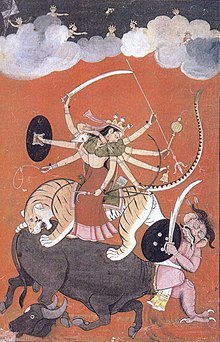
INFORMATION: Durga is one of the angry and aggressive aspects of the goddess Sakti, whose earliest role in Hindu mythology is to fight and conquer demons but how also personifies the Sakti or female aspect of any male deity. Iconographically, Durga is depicted as a beautiful golden-skinned woman who rides upon a lion or a tiger. She has eight or ten arms, each bearing a weapon presented to her by different gods including the conch shell of Visnu, the trident of Siva, the bow of Rama and the sudarshan (spoked disc) of Krsna. These gifts extend to her the power of the eight or ten gods. She may wear a necklace of skulls. She is associated with the Himalaya and Vindhya mountains and is often depicted slaughtering the buffalo-demon Mahisa by thrusting her trident into his body.
In a contrasting aspect in later Hindu traditions, Durga takes the role of a mother goddess and consort of Siva and becomes partly syncretized with Parvati. She is also linked with the fertility of crops. In this capacity her most important festival is the Durga Puja, celebrated at harvest time, during which devotees persistently make obscene gestures and comments to stimulate her fecundity. She is depicted flanked by four other deities, Laksmi, Sarasvati, Ganesa and Karttikeya, who are said to be her children.
In general Durga is perceived in northern India as the gentle bride epitomizing family unity, while in souther India she is revered more in her warlike murderous aspect.